
Imagine a system that handles over two million individual cases at any given moment. That’s the immense scale of Canada’s immigration framework. My analysis digs into the current state of this system to give you a clear picture of what to expect.
In 2024, the department finalized a staggering number of decisions across all programs. This volume highlights the system’s capacity and the challenges in managing expectations. The government is actively working to balance new arrivals with national needs.
How long you wait depends on several key factors. These include annual immigration targets, the complexity of your specific case, and how promptly you reply to any requests for more details. Most submissions are completed within the published service standards.
My goal is to provide transparent, data-driven insights. I want to help you plan your strategy effectively and set realistic expectations for your journey to Canada.
Key Takeaways
- Canada’s immigration system manages an enormous volume of applications simultaneously.
- Government policies aimed at stabilizing resident numbers directly influence wait periods.
- The complexity of an individual case is a major factor in its timeline.
- Applicant responsiveness to information requests can significantly speed up the process.
- The majority of cases are finalized within the officially stated service standards.
- Understanding these factors is crucial for setting realistic expectations.
Introduction
Navigating Canada’s immigration framework requires understanding the complex interplay of multiple variables that determine how quickly cases move through the system. My analysis examines these critical elements to provide clarity on what influences case progression.

Purpose of the Analysis
This report aims to deliver comprehensive, transparent information about how applications move through Canada’s immigration system. I focus on providing actionable insights that help people understand the current state of application handling across major categories.
The analysis goes beyond simple averages to explore underlying causes of delays. It examines which elements applicants can control and how to position submissions for optimal handling.
Overview of Report Methodology
My approach involves examining official operational data from January through August 2025. I compare year-over-year trends and service standard achievement rates while incorporating professional insights.
The methodology accounts for seasonal variations and policy adjustments. This provides context for understanding wait period differences across various immigration programs.
| Factor Category | Key Elements | Impact Level |
|---|---|---|
| Operational Factors | Staffing levels, digital transition, backlog management | High |
| Application Factors | Completeness, accuracy, supporting documentation | Medium-High |
| Applicant Factors | Response time to requests, country of origin | Medium |
| Program Factors | Application type, complexity, security requirements | Variable |
IRCC processing times 2025: An In-Depth Overview
My analysis of key performance indicators shows significant variation in how different application types are handled. This section provides a detailed look at the metrics that define the current state of affairs.
It examines both achievements and areas where the system continues to face challenges. The data offers a clear snapshot of what applicants can realistically expect.
Key Metrics and Service Standards
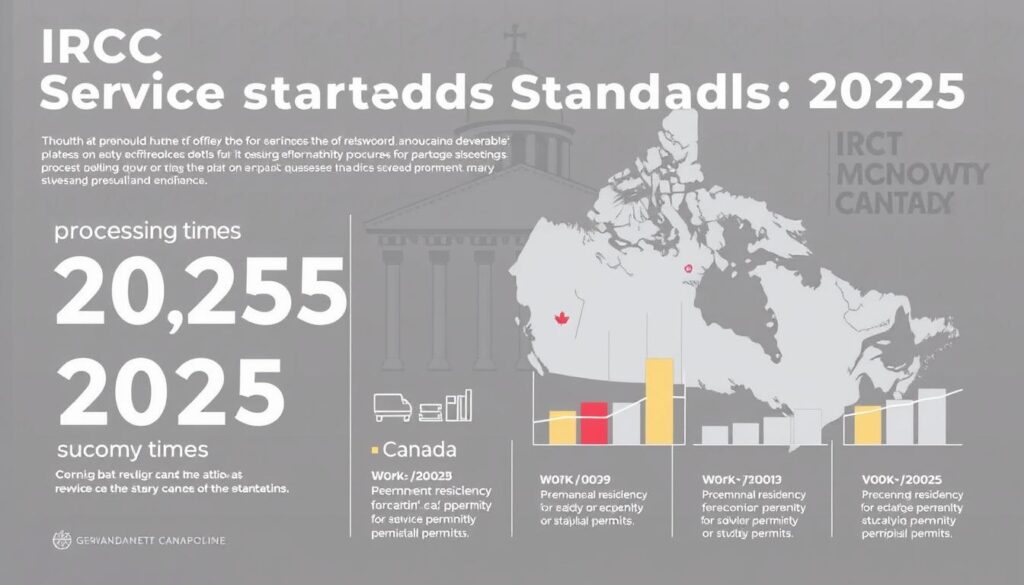
Service standards are the publicly stated goals for how long an application should take. They vary by program and act as a crucial benchmark for efficiency.
As of late April 2025, only 56% of permanent residence applications were finalized within their established service standards. This falls notably short of the department’s goal to process 80% of cases on time.
The 80% target intentionally allows for complex cases that require extra verification. This includes detailed security screening or reviews of medical information.
Recent Trends and Changes
Encouraging improvements are evident in specific categories. Citizenship grant applications now average 9 months, a significant decrease from 14 months the previous year.
This demonstrates that efficiency initiatives are yielding positive results. For temporary residence, study permits are processed in about 45 days, well within the 60-day standard.
A critical clarification was made regarding how duration is calculated. The clock now starts when a complete application is received, not from the initial expression of interest.
My research confirms a consistent trend: online submissions are handled faster than paper-based ones across all categories. This reinforces the importance of the ongoing digital transformation.
Factors Influencing Application Processing Times
My investigation reveals that the speed of an immigration case is not random but shaped by a distinct set of internal and external pressures. These elements interact to create the final timeline for a decision.
Some of these influences are within an applicant’s direct control. Others are tied to broader operational realities.

Careful preparation is the most powerful tool an individual possesses. Submitting a flawless file is the first step toward a smoother journey.
Operational and Staffing Challenges
Systemic factors play a huge role. Fluctuating resource levels and policy changes have created uneven performance across different streams.
Some programs have recovered well, while others continue to face significant backlogs. This directly affects how new submissions are handled.
| Factor Category | Key Influence | Control Level |
|---|---|---|
| Applicant-Controlled | Document completeness, response speed | High |
| External Variables | Medical exam availability, local office workload | Low |
| Case Complexity | Previous history, family details, security checks | Medium |
The type of submission itself dictates the baseline for its handling. Simpler cases, like visitor visas, often proceed much faster than complex permanent residence applications.
My analysis confirms that straightforward cases with complete documentation and no complicating issues receive decisions more quickly. A prompt reply to any request for information is also critical to avoid unnecessary pauses.
Trend Analysis for Permanent Residence Applications
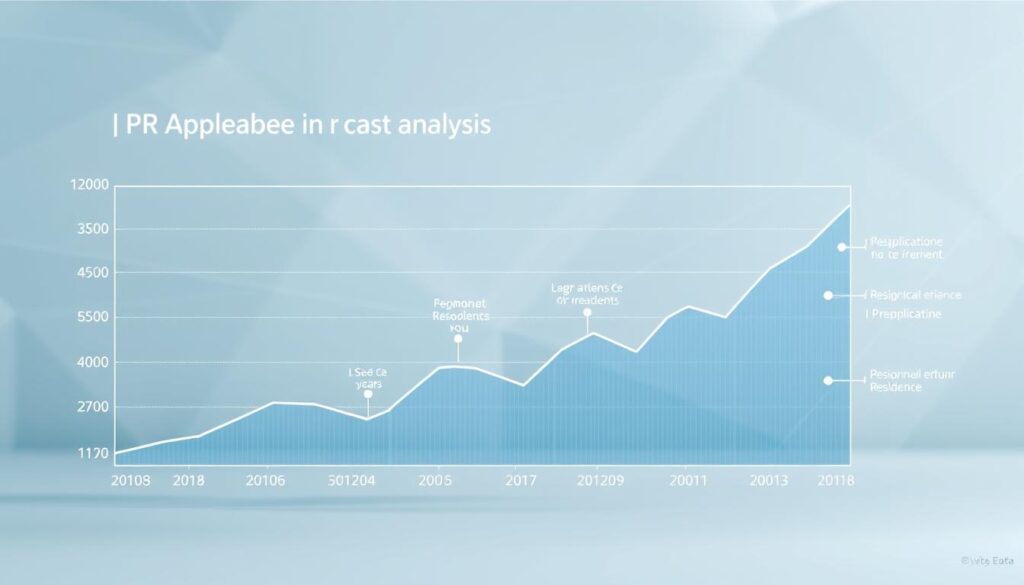
Recent data reveals a strategic shift in Canada’s permanent residence application landscape. Intake volumes decreased significantly while decision output remains robust.
Performance Metrics and Backlog Insights
My analysis shows a 47% reduction in new applications from January to April compared to the same period last year. Despite this decrease, the department maintained strong decision-making capacity.
Only 56% of permanent residence applications currently meet established service standards. This falls short of the 80% target but reflects ongoing system adjustments.
| Program | Current Timeline | Service Standard Met |
|---|---|---|
| Canadian Experience Class | 4.7 months | Yes |
| Quebec Skilled Workers | 6.9 months | Yes |
| Express Entry General | 6-8 months | Partial |
| Non-Express Entry PNP | 18-22 months | No |
Impact of Express Entry and Provincial Nominee Programs
The Express Entry system continues as the fastest pathway to permanent residence. Most applications complete within 6-8 months, with the Canadian Experience Class performing exceptionally well.
Provincial nominee program timelines show dramatic variation. Express Entry-linked applications process in 6-8 months, while paper-based submissions take 18-22 months.
Ontario, Alberta, and British Columbia currently demonstrate the shortest wait times. This provincial variation suggests applicants should consider local processing capacity when planning their strategy.
Analysis of Work Permit and Study Permit Processing
My examination of temporary resident pathways reveals a dynamic landscape where efficiency varies significantly between different permit categories. The department has maintained strong output despite deliberate policy measures to stabilize intake volumes.
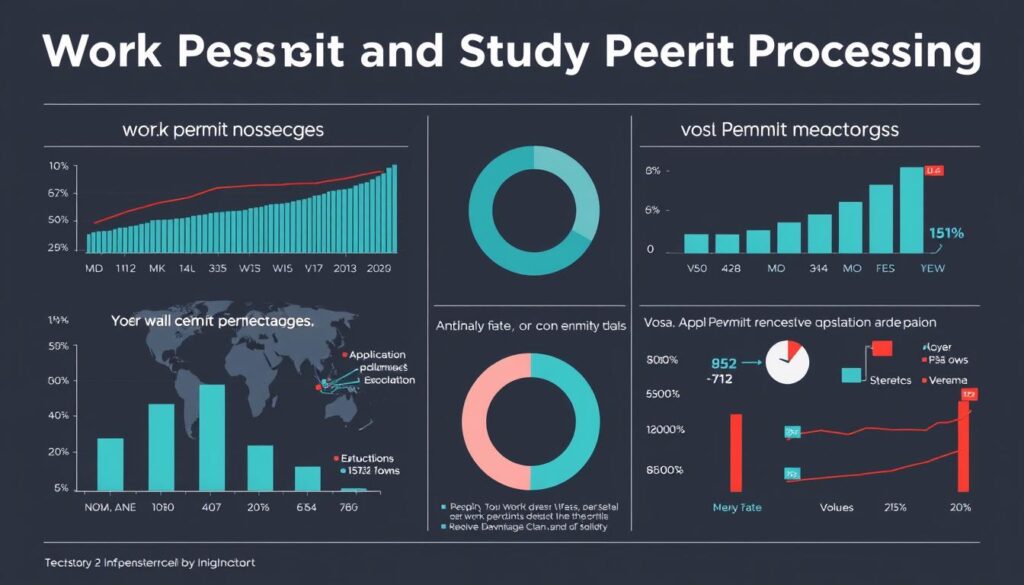
From January to April 2025, temporary resident applications saw a 27% decrease in intake compared to the same period last year. This reflects strategic adjustments while maintaining robust decision-making capacity.
Processing Efficiency and Service Target Achievements
Study permit applications demonstrate particularly strong performance. New study permits were processed in just 45 days as of April 30, 2025, comfortably meeting the 60-day service standard.
Work permit processing shows more variation depending on the specific category. Employer-specific permits requiring LMIA approval take 10-12 weeks, while open work permits for spouses process within 6-10 weeks for applicants inside Canada.
| Permit Type | Average Processing Time | Service Standard Met |
|---|---|---|
| New Study Permit | 45 days | Yes |
| Employer-Specific Work Permit | 10-12 weeks | Partial |
| Open Work Permit (Spouses) | 6-10 weeks | Yes |
| Study Permit Extension | 8-12 weeks | Yes |
The temporary resident inventory decreased by 24% between April 2024 and April 2025. This indicates successful backlog reduction while managing lower application volumes.
Prospective international students should apply for their study permit as early as possible, ideally by May for September admission. This accounts for potential delays and ensures timely permit receipt.
Impact on Citizenship and Passport Processing
Becoming a Canadian citizen represents the final step for many immigrants, and current data shows encouraging progress. My analysis reveals substantial improvements in how these important applications are handled.
Comparative Overview of Processing Timelines
The citizenship grant application timeline has shortened dramatically. Processing now averages 9 months, down from 14 months last year. This places it well within the 12-month service standard.
Canada welcomed nearly 108,000 new citizens from January to April. While this represents a decrease from 2024, it reflects strategic inventory management. The department finalized more applications than it received during this period.
| Service Type | January-April 2025 Intake | Processing Output | Efficiency Change |
|---|---|---|---|
| Citizenship Grant Applications | 104,270 | 116,318 decisions | 15% faster than intake |
| Passport Applications | 31,623 | 40,976 processed | 35% increase from 2024 |
Complete documentation remains crucial for smooth citizenship grant processing. Delays often occur when travel history requires verification or application packages contain discrepancies.
Passport services show equally impressive gains. Intake increased by 40% while processing output grew by 35%. This demonstrates enhanced operational capabilities across citizenship and travel document services.
IRCC Digital Transformation and Service Standards
Canada’s immigration system is undergoing a significant technological revolution that is reshaping how applications are managed. This digital evolution represents one of the most important developments in recent years.
Advancements in Automation and Digital Platforms
My analysis reveals substantial investments in automation technologies. These include advanced analytics and Robotic Process Automation systems.
These tools handle routine tasks more efficiently. This allows officers to focus on complex cases requiring detailed assessment.
The Digital Platform Modernization initiative promises comprehensive service improvements. New platforms provide greater flexibility and system stability across all immigration programs.
Shifts from Paper-Based to Online Applications
Online submissions are consistently processed faster than paper-based applications. This applies across all immigration categories.
The department has enhanced transparency through digital case tracking tools. Applicants receive more frequent status updates, particularly for Express Entry and family sponsorship streams.
Priority categories receive expedited handling. These include healthcare workers, in-Canada family sponsorships, and permanent residents applying domestically.
Digital platforms also reduce application errors and communication delays. This improves the overall applicant experience while increasing approval rates.
Client Support and Application Backlogs
My assessment of client support channels reveals a system grappling with increased public inquiry while managing immense application volumes. The data from early this year shows a clear picture of these interconnected challenges.
Demand for phone support rose by 13%, with over 1.5 million requests. However, the number of calls handled decreased by 5%. This indicates growing pressure on these resources.
Email operations performed better. Intake grew by 5%, but output increased by 9%. This shows a positive trend in managing digital inquiries.
Insights from the Client Support Centre
The following table summarizes key operational metrics from January to April, highlighting the varying performance across different support channels.
| Support Channel | Intake Volume | Output Volume | Year-over-Year Change |
|---|---|---|---|
| Phone Operations | 1,546,256 | 611,186 | +13% intake, -5% output |
| Email Operations | 817,065 | 873,680 | +5% intake, +9% output |
| Ministerial Centre (MCMPS) | 137,656 | 137,656 | -8% (all cases resolved) |
| Crisis Phone Lines | 2,826 | 2,758 | -78% intake |
Crisis channel usage fell dramatically. This reflects the evolving global situation, with only one dedicated line remaining active.
The department manages over two million cases at any time. It’s vital to understand that this inventory includes both applications within service standards and those constituting a true backlog.
If applicant numbers exceed available spaces, wait periods may lengthen. This occurs regardless of operational improvements. Setting realistic expectations is crucial for all applicants.
Conclusion
As I conclude this analysis, several key patterns emerge from the data examined. My research throughout this year confirms that while certain categories show impressive gains, the system continues to evolve.
Digital transformation initiatives are yielding measurable benefits. Online submissions consistently outperform paper-based application methods across all immigration categories. This demonstrates the value of continued technological investment.
For prospective applicants, thorough preparation remains the most effective strategy. Complete documentation and prompt responses significantly influence processing outcomes. Understanding current timelines by program type helps set realistic expectations.
While processing times may fluctuate, the majority of cases finalize within established standards. Strategic planning and professional guidance when needed position applicants for success in their Canadian immigration journey.