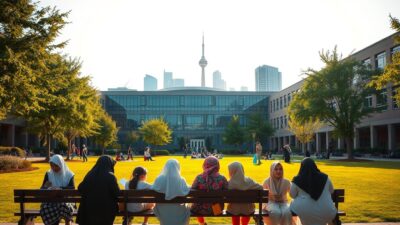


What if moving your family to Canada’s largest city was more achievable than you ever imagined? Many people assume that life in this vibrant metropolis is out of reach, but with the right information, your dream can become a reality.
I created this detailed guide because I faced the same questions when I first considered relocating. Understanding the true expenses was the key to making an informed decision. This city is a hub of opportunity, and I want to help Arab families navigate it successfully.
Let’s look at the numbers. For a single person, a comfortable lifestyle requires approximately $3,417 monthly. A family of four should budget for around $7,532 each month. These figures cover housing, food, transportation, and other essentials.
This resource will explore all major expense categories. We will cover everything from finding a home to managing utilities and healthcare. I will also address unique considerations for Arab families, like accessing halal food and community resources.
While this is the second most expensive city in Canada, strategic planning makes it accessible. My guide uses current 2025 data and real-world experience to provide accurate, practical advice for your journey.
Key Takeaways
- Toronto offers significant opportunities but requires careful financial planning for families.
- A single person needs an estimated $3,417 per month for a comfortable lifestyle.
- A family of four should plan for monthly expenses of approximately $7,532.
- This guide provides a breakdown of all major budget categories, including housing and food.
- Special considerations for Arab families, such as halal food access, are included.
- Informed budgeting can make living in this dynamic city a realistic goal.
- All information is based on authoritative 2025 data and real-life experience.
Toronto 2025: An Overview of the Financial Landscape
Choosing to settle in one of North America’s most vibrant urban centers presented both financial hurdles and remarkable opportunities. This city in Canada offers a unique blend of economic challenges and lifestyle benefits that require careful consideration.
Why I Chose Toronto for My Home
I selected this location despite knowing it was an expensive city because of its unparalleled multicultural environment. The established Arab community with mosques, halal restaurants, and Arabic services made the transition smoother for my family.
The economic opportunities also weighed heavily in my decision. With average salaries exceeding $102,000 annually, the potential for professional growth outweighed the higher expenses. The quality education system and diverse job market provided long-term stability.
Key Budget Considerations for Arab Families
Several factors require special attention when planning your move to Toronto. Halal food sourcing may involve slightly higher costs, and religious education or community events need dedicated funding.
Understanding these unique expenses helps transform what seems challenging into an achievable goal. Proper planning allows families to enjoy the city’s rich cultural offerings while maintaining financial stability.
Decoding the “cost of living toronto” for Diverse Lifestyles
Your monthly budget in Toronto will look dramatically different depending on whether you’re studying solo, building a career alone, or raising a family. I’ve analyzed how expenses break down across these categories to help you plan effectively.

Comparing Expenses for Singles, Students, and Families
Students typically manage with $1,800-$2,300 monthly. Their largest expense is rent at $1,100-$1,500. Food costs range from $200-$400.
A single person needs $3,000-$4,000 per month. Housing takes $1,200-$1,895. Transportation averages $140-$250.
Families of four require $7,600-$8,500 monthly. Rent consumes $2,400-$3,500. Food expenses hit $1,000-$2,200.
Major Factors Influencing Costs in 2025
Inflation and housing market dynamics significantly impact the average cost living. Food prices are rising sharply – families may pay $801.56 more annually.
International students face additional challenges like tuition costs and work restrictions. Seasonal variations also affect utility bills and entertainment expenses.
Understanding these factors helps with strategic planning. For broader Canadian financial insights, explore this comprehensive guide to expenses across the.
Housing and Rental Markets in Toronto
Finding the right home became my top priority when planning our move. Housing represents the largest single expense in any budget, often consuming 40-50% of monthly income.
Rent Trends in Downtown versus Outside the City Centre
Location dramatically affects rental prices. A one-bedroom apartment in the city centre costs $2,200-$2,700 monthly. The same unit outside downtown runs $1,800-$2,100.
This represents potential savings of $400-$600 monthly. For families, three-bedroom apartments cost approximately $3,560 downtown versus $2,907 outside the centre.
Buying Property vs. Renting: What I Learned
I carefully weighed the decision between buying and renting. Property purchase prices range from $349,000-$699,999 depending on location.
Homeowners must also budget for annual property taxes of $6,500-$7,000. Renting offers flexibility for newcomers still establishing themselves.
Sharing accommodations can reduce individual housing costs to $700-$1,000 monthly. However, this option may not suit families seeking privacy.
Utility Bills and Transportation Expenses in Toronto
After securing housing, utility expenses and commuting options emerged as the next critical components of our budget planning. These ongoing monthly outlays require careful management to maintain financial stability.
Understanding Monthly Utility Costs
Utility bills in this city fluctuate significantly with seasonal changes. During harsh winters when temperatures drop to -25°C, heating costs spike dramatically.
Most households should budget $350-$400 monthly for essential services. This amount covers electricity, heating, water, and garbage collection at $120-$145.
Additional utilities include gas service ($140-$220), mobile phone plans ($35-$90), and internet ($56-$100). Water bills can rise during summer months for families maintaining lawns or gardens.

Navigating Public Transit and Car Expenses
Toronto’s public transit system (TTC) offers excellent value for daily commuters. A monthly pass costs $156 and provides unlimited travel on subways, buses, and streetcars.
Single fares run $3.35 per trip for adults. For families with teenagers, youth passes at $2.40 represent significant savings.
Car ownership involves substantial additional expenses. Mandatory insurance averages $2,045 annually, plus gas, maintenance, and parking fees.
I recommend choosing accommodations near transit lines to reduce transportation costs. Strategic planning of grocery shopping trips also minimizes travel expenses for Arab families.
Grocery and Daily Meal Costs in Toronto
When I first arrived, I was surprised by how much strategic planning could reduce our monthly food bills. Understanding current grocery prices is essential for maintaining your budget.
Food represents the second-largest expense category for most households. According to recent data, families of four should anticipate spending approximately $16,833 annually on nourishment.
Average Prices for Essential Food Items
Knowing current market rates helps you shop smarter. Here are typical prices for staples that Arab families frequently purchase:
| Food Item | Price Range | Unit | Notes |
|---|---|---|---|
| White Rice | $2.30-$10.00 | 2kg | Basic staple for many meals |
| Chicken Fillets | $10.00-$25.99 | 1kg | Halal options may be higher |
| Beef Round | $10.00-$30.00 | 1kg | Quality affects price significantly |
| Fresh Tomatoes | $3.00-$8.80 | 1kg | Seasonal variations apply |
| Local Cheese | $7.99-$35.00 | 1kg | Imported varieties cost more |
Planning a Balanced Meal Budget
Meal preparation at home offers substantial savings compared to dining out. A restaurant meal for two people typically costs $75-$220, while home-cooked alternatives are far more economical.
Students typically spend $200-$400 per month on groceries. Single professionals budget $450-$800 monthly. Families allocate $1,000-$2,200 for their nourishment needs.
Strategic shopping at Middle Eastern specialty stores often yields better prices for traditional ingredients. Buying lentils, chickpeas, and spices in bulk maintains cultural diets while managing expenses effectively.
Healthcare, Insurance, and Education Expenses
Navigating medical coverage and schooling options required careful financial planning during our relocation process. These essential services significantly impact your monthly budget.

Managing Health Insurance and Medical Costs
Canada’s healthcare system provides coverage to residents through provincial plans like OHIP. Newcomers face a three-month waiting period before eligibility begins.
During this transition, private insurance becomes essential. Comprehensive coverage typically ranges from $75-$150 monthly per person.
Additional medical expenses often surprise families. Dental care, vision services, and prescription medications can add $100-$300 to your monthly budget.
Budgeting for Tuition and School Supplies
Education represents a significant investment for families. International students automatically receive health insurance through programs like Guard.Me upon enrollment.
Academic expenses vary considerably by institution and program. Here’s a breakdown of typical education-related costs:
| Expense Category | Annual Amount | Frequency | Notes |
|---|---|---|---|
| Books & Supplies | $500 | Per year | Can be reduced with used materials |
| Technology (Laptop) | $800-$1,800 | One-time | If not already owned |
| Additional Fees | Varies | Annual | Field trips, sports, activities |
Families have multiple schooling options available. Public institutions serve residents without tuition fees, while private and Islamic schools range from free to $15,000+ annually.
Quality education represents an investment in your family’s future, providing exceptional value despite the initial costs.
Strategic planning helps manage these expenses effectively. Scholarships, used textbooks, and student discounts offer valuable savings opportunities.
Entertainment and Leisure: Balancing Fun with Finances
Discovering affordable leisure options became essential for my family’s happiness after we settled in. While these expenses are discretionary, they contribute significantly to wellbeing and cultural integration.
Monthly entertainment spending varies by household type. Students typically allocate $130-$150, while singles budget $160-$220. Families often plan for $300-$450 in leisure activities.
Cost of Cultural and Recreational Activities
Toronto offers diverse attractions with varying price points. Understanding these costs helps families plan memorable outings without financial stress.
| Attraction | Price Range | Family-Friendly |
|---|---|---|
| Royal Ontario Museum | $12.80-$26.80 | Yes |
| Ripley’s Aquarium | $12.50-$29.00 | Yes |
| Toronto Zoo | $13-$26 | Yes |
| CN Tower | $25-$45 | Yes |
Finding Affordable Entertainment Options
I discovered numerous budget-friendly strategies during our first year. Free museum days, community festivals, and park visits provide excellent value.
Arab families can particularly benefit from cultural events within the community. These often feature minimal or no cost while offering meaningful connections.
Balancing entertainment spending with financial goals remains crucial. Allocating a specific percentage of your budget ensures enjoyment without compromising essential expenses.
Cost Comparison: Toronto vs. Other Major Canadian Cities
When researching potential Canadian homes, I discovered significant differences in expenses between major urban centers. This comparison provides crucial perspective for families considering relocation options across the country.
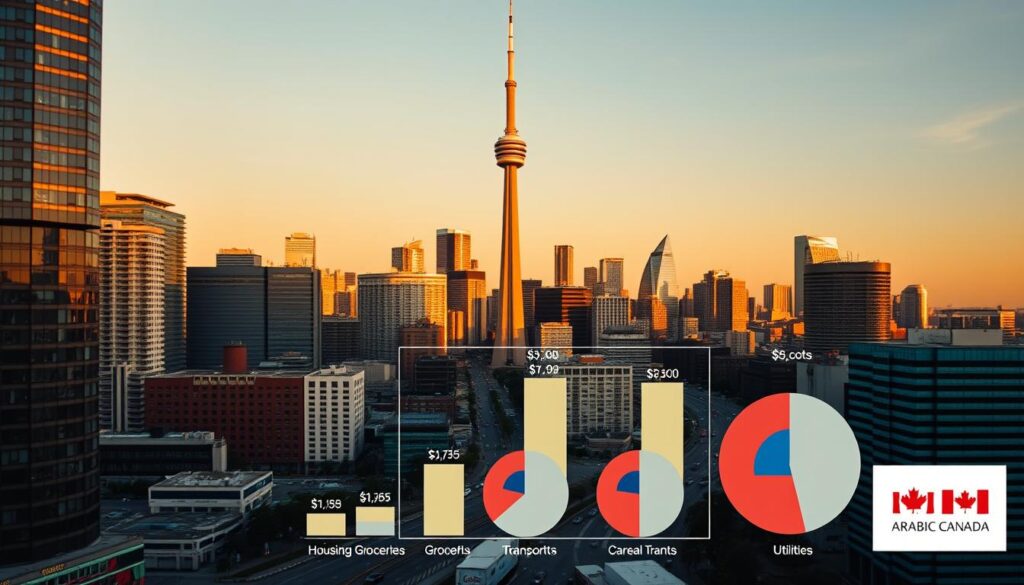
How Toronto Stacks Up Against Montreal, Calgary, and More
Monthly requirements vary dramatically across metropolitan areas. A single person needs $3,600-$4,000 in Toronto compared to $3,275-$3,800 in Montreal.
Calgary offers even more affordable options at $3,000-$3,600 per month. Ottawa and Vancouver present similar financial demands to Toronto’s urban landscape.
Family budgets show even greater disparities. A household of four requires $7,600-$8,500 monthly here. Montreal families manage with $5,750-$6,500, while Calgary households budget $5,100-$6,700.
Beyond pure numbers, each city offers distinct lifestyle trade-offs. Montreal provides vibrant culture but has language considerations. Calgary boasts strong job markets yet lacks Toronto’s international connectivity.
For Arab families, community infrastructure becomes equally important. The established networks here justify the premium for many seeking cultural acceptance and religious resources.
Ultimately, your choice depends on balancing financial constraints with career opportunities and community needs. Every urban center presents unique advantages worth careful consideration.
Understanding Taxation and Average Salaries in Toronto
The relationship between gross earnings and net income became immediately apparent during my initial budget planning. Understanding Ontario’s tax structure is essential for accurate financial forecasting.
Ontario Income Tax Rates and Their Impact
Ontario uses a progressive tax system with rates starting at 5.05% for income up to $52,886 per year. These rates increase through several brackets, reaching 13.16% for earnings over $220,000 annually.
A $70,000 salary toronto yields approximately $52,600 after taxes. This translates to $4,300 monthly for basic living expenses. While sufficient for an individual, it leaves little room for savings.
A $90,000 salary provides $63,600 take-home pay or $5,300 monthly. This offers a comfortable lifestyle for a single person with occasional travel and entertainment.
What a Good Salary Looks Like in Toronto
The average salary toronto is $102,062 per year. However, a good salary depends on your household size and lifestyle expectations.
For an individual, $54,000-$60,000 annually provides comfortable living. Families typically need $10,000-$12,000 monthly income, requiring two working adults.
Strategic tax planning can maximize your take-home pay. RRSP contributions and family tax credits help offset the high cost living in this dynamic city.
Practical Budgeting Tips for a Stress-Free Life
The key to financial peace in an expensive urban environment lies in systematic budget management. I found that implementing clear frameworks transformed our household finances from chaotic to controlled.

Effective Strategies to Manage Expenses
I follow the 50-30-20 rule for allocating after-tax income. This means 50% covers essential needs like housing and groceries. Another 30% goes toward wants such as entertainment. The remaining 20% builds savings for future security.
Strategic choices significantly reduce major monthly expenses. Choosing accommodations outside the city center can save hundreds monthly. Using public transit instead of car ownership eliminates insurance and maintenance costs. Meal preparation at home cuts food spending by 30-40%.
Tools and Resources for Budget Planning
Digital tools make tracking simpler. I use apps that automatically categorize spending. This helps identify patterns and areas for improvement. For broader financial insights, explore this comprehensive guide to expenses across the country.
The right mindset supports successful financial management. View budgeting as empowerment rather than restriction. Celebrate small victories and focus on long-term family goals.
Preparing for Your Move: Logistics and Planning Essentials
Moving logistics represent one of the most overlooked yet critical aspects of international relocation that I learned through personal experience. Proper preparation significantly impacts both transition smoothness and overall expenses.
Deciding Between DIY Moving and Hiring Professionals
Professional movers in Downtown Toronto charge $139-$199 per hour for local moves. This includes two movers and a truck. Long-distance relocations require additional services like packing and storage.
DIY moving suits individuals with flexible timelines and minimal belongings. Students often choose this option to manage their budget effectively.
| Moving Option | Best For | Estimated Cost | Time Required |
|---|---|---|---|
| DIY Moving | Students, singles, minimal items | $500-$1,500 | Flexible timeline |
| Professional Movers | Families, long distance, fragile items | $2,000-$5,000+ | 1-3 days |
Decluttering before your move reduces volume and expenses. Obtain multiple quotes and schedule during off-peak seasons for better rates.
A well-planned relocation sets the foundation for a successful transition, turning potential stress into organized progress.
International moves require customs planning and temporary accommodation. Connect with local Arab communities for support during this important life change.
Conclusion
The journey through Toronto’s financial landscape reveals that strategic preparation transforms what seems challenging into achievable family goals. This comprehensive guide provides the foundation for making informed decisions about living in this vibrant city.
While Toronto ranks as Canada’s most populous city with higher expenses, the rewards justify the investment. Arab families benefit from established communities, cultural acceptance, and religious resources that enhance quality of life.
Remember that individual circumstances vary based on lifestyle choices and family size. View financial planning as empowerment rather than restriction. With average salaries exceeding $102,000, the income potential supports the lifestyle outlined throughout this resource.
Approach your relocation with both realism and optimism. Careful budgeting and community connections will help your family thrive in this dynamic urban environment.
FAQ
What is the average monthly budget for a single person in Toronto?
How much should an Arab family budget for groceries per month?
FAQ
What is the average monthly budget for a single person in Toronto?
From my research, a single individual can expect monthly expenses to range between ,500 and ,500. This budget covers a one-bedroom apartment outside the city centre, groceries, transportation, and basic entertainment. Your personal spending habits will ultimately determine the final amount.
How much should an Arab family budget for groceries per month?
Based on my own meal planning, a family of four typically spends around 0 to
FAQ
What is the average monthly budget for a single person in Toronto?
From my research, a single individual can expect monthly expenses to range between $3,500 and $4,500. This budget covers a one-bedroom apartment outside the city centre, groceries, transportation, and basic entertainment. Your personal spending habits will ultimately determine the final amount.
How much should an Arab family budget for groceries per month?
Based on my own meal planning, a family of four typically spends around $800 to $1,200 monthly on groceries. This estimate includes sourcing specific ingredients from specialty stores. Shopping at chains like Loblaws or No Frills for staples can help manage this essential expense.
Is a car necessary for living in Toronto, or is public transit sufficient?
I’ve found the Toronto Transit Commission (TTC) system to be highly reliable for daily commutes within the city. For most people living and working downtown, a car is an optional, significant added cost. However, families with children or those frequently traveling outside the city centre may find a vehicle more convenient.
What is a good salary to live comfortably in Toronto in 2025?
To maintain a comfortable lifestyle that includes housing, savings, and leisure, I believe an annual salary of $80,000 or more for a single person is a solid target. For a family, a combined household income exceeding $120,000 provides a better buffer for unexpected costs and a higher quality of life.
What are the biggest financial surprises newcomers face?
In my experience, the initial costs of setting up a new home are often underestimated. These include first and last month’s rent, furniture, and deposits for utilities. Additionally, the high price of dining out and entertainment can quickly impact your monthly budget if not planned for carefully.
How do education expenses factor into a family’s budget?
For families with school-aged children, education is a major budget line. While public school is funded through taxes, costs for supplies, extracurricular activities, and tutoring add up. For international students or those considering private institutions like the University of Toronto, tuition is a significant, long-term financial commitment.
,200 monthly on groceries. This estimate includes sourcing specific ingredients from specialty stores. Shopping at chains like Loblaws or No Frills for staples can help manage this essential expense.
Is a car necessary for living in Toronto, or is public transit sufficient?
I’ve found the Toronto Transit Commission (TTC) system to be highly reliable for daily commutes within the city. For most people living and working downtown, a car is an optional, significant added cost. However, families with children or those frequently traveling outside the city centre may find a vehicle more convenient.
What is a good salary to live comfortably in Toronto in 2025?
To maintain a comfortable lifestyle that includes housing, savings, and leisure, I believe an annual salary of ,000 or more for a single person is a solid target. For a family, a combined household income exceeding 0,000 provides a better buffer for unexpected costs and a higher quality of life.
What are the biggest financial surprises newcomers face?
In my experience, the initial costs of setting up a new home are often underestimated. These include first and last month’s rent, furniture, and deposits for utilities. Additionally, the high price of dining out and entertainment can quickly impact your monthly budget if not planned for carefully.
How do education expenses factor into a family’s budget?
For families with school-aged children, education is a major budget line. While public school is funded through taxes, costs for supplies, extracurricular activities, and tutoring add up. For international students or those considering private institutions like the University of Toronto, tuition is a significant, long-term financial commitment.